Impact Driver vs Drill — Which Do You Need First?
Buy the drill/driver first: its adjustable chuck grips round drill bits and hex driver bits alike, while an impact driver's 1/4-inch hex chuck only accepts hex-shank bits — so the drill covers both holes and screws, and the impact driver earns its slot later as the dedicated fastening tool.
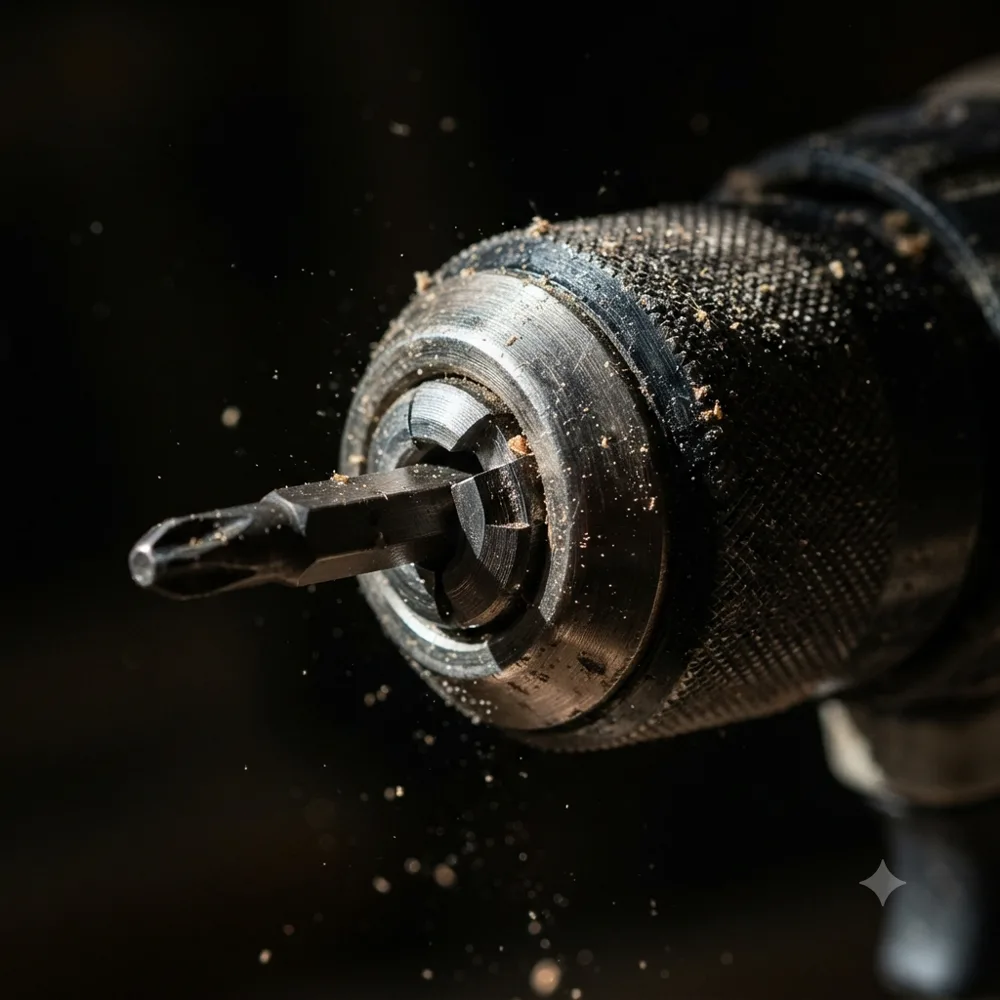
The chuck difference, precisely: Impact drivers use a 1/4-inch hex quick-release chuck that accepts hex-shank bits and hex-shank socket adapters — a friction-fit, tool-free system. Impact wrenches use a square drive (most commonly 1/2-inch, also 3/8-inch or 3/4-inch for bigger wrenches) that accepts standard sockets and is secured by a detent ball or friction ring, matching the same square-drive standard as a manual socket wrench. The two are not interchangeable without an adapter, and adapters add length and a failure point under high torque.
Why the impact driver is the best second tool
Torque units signal tool class: impact drivers are rated in inch-pounds (in-lbs, typically 1,400–2,500), impact wrenches in foot-pounds (ft-lbs, roughly 100 to 1,000+), and drills report a lower in-lbs figure at their low-speed setting where torque peaks and speed drops. To compare across units, divide ft-lbs figures by 12 to get in-lbs (or multiply in-lbs by 12 for ft-lbs) — a 400 ft-lb impact wrench equals 4,800 in-lbs, roughly double even a strong impact driver's output, which is why wrenches and drivers aren't interchangeable for lug nuts versus deck screws.
That torque gap is why two-tool combo kits pair a drill with an impact driver rather than two drills. Once you are driving deck screws, lag bolts, or long structural fasteners regularly, an impact driver stops being optional — compare current 18V-class impact drivers on Amazon against the two class picks below.
Impact driver picks
DeWalt 20V MAX XR Brushless Impact Driver (DCF887B)
18V nominal, 1/4-in hex, ~1,825 in-lbs torque, brushless, 3-speed + precision drive mode
A precision drive mode drops power for small screws so you don't strip or overdrive them — genuinely useful for cabinet/trim work.
Best for: Mixed-use buyers doing everything from deck screws to delicate furniture assembly
Watch out: Sold bare in most listings — needs a compatible 20V MAX battery and charger, which most first-time buyers won't already own.
Check price on AmazonNot deciding today? Add it to your cart over there — Amazon keeps it saved (and flags any price change) until you're ready.
Milwaukee M18 FUEL Impact Driver (2853-20)
18V nominal, 1/4-in hex, ~1,800 in-lbs torque, brushless FUEL motor, 4-mode drive control
Milwaukee's FUEL line pairs the brushless motor with dedicated electronics for stronger sustained output under load.
Best for: Users who drive lag bolts and large fasteners regularly, not just deck screws
Watch out: The FUEL line's batteries and tools carry a real price premium over Milwaukee's standard M18 lineup for a torque gain many users won't notice day to day.
Check price on AmazonNot deciding today? Add it to your cart over there — Amazon keeps it saved (and flags any price change) until you're ready.
Frequently Asked Questions
Buy the drill/driver first. Its adjustable chuck grips round drill bits and hex driver bits alike, so one tool covers both drilling holes and driving screws. An impact driver’s 1/4-inch hex quick-release chuck only accepts hex-shank bits, so on its own it cannot cover normal drilling with round-shank bits — it is the better second tool, not the better first one.
It delivers far more fastening torque. Impact drivers are rated in inch-pounds and typically land in the 1,400–2,500 in-lbs range — the DeWalt DCF887 is rated around 1,825 in-lbs and the Milwaukee M18 FUEL 2853-20 around 1,800 in-lbs — versus roughly 300–750 in-lbs for common 18V-class drill/drivers. That headroom is what makes lag bolts, deck screws, and long fasteners easy.
No. Impact drivers use a 1/4-inch hex quick-release chuck; impact wrenches use a square drive (most commonly 1/2-inch) that accepts standard sockets. They are not interchangeable without an adapter, adapters add length and a failure point under high torque, and wrench-class torque is measured in foot-pounds — a 400 ft-lb impact wrench equals 4,800 in-lbs, roughly double even a strong impact driver’s output.
Both drills and impact drivers publish inch-pounds, but drills report their figure at the low-speed setting where torque peaks, and impact wrenches switch to foot-pounds entirely. To compare across units, multiply ft-lbs by 12 to get in-lbs. The unit itself signals the tool class.